Real vs. Fake Montessori: 8 Questions to Ask
A parent’s field guide
The real question is not whether a school looks Montessori. It is whether the adults, schedule, materials, and classroom culture work together in a genuinely Montessori way.
Because the word “Montessori” is not trademarked, any school can put it on a sign. A room may have wooden shelves, neutral colors, and a few familiar materials without following the method in any meaningful depth. That leaves parents with an unfairly difficult job: separating a practiced educational approach from a marketing label.
You do not need Montessori training to make that distinction. You need specific questions and enough time to listen closely. A strong school will welcome careful questions, explain its choices plainly, and let you see how those choices affect children. Treat your tour as consumer research, then look for the following eight answers.
1. What Montessori training do the lead guides have?
Ask who trained each lead guide, what age level the credential covers, and whether the program included supervised classroom practice. “Certified teacher” is not a complete answer. A state teaching license, an early childhood degree, and a Montessori credential prepare educators for different work. Each may be valuable, but they are not interchangeable.
A credible answer names the training organization and connects the guide’s credential to the classroom level. It also distinguishes lead guides from assistants. Assistants play an important role, but the adult giving lessons, observing progress, and preparing the environment should have substantial Montessori preparation. If the school says every teacher is “Montessori inspired” but cannot describe formal training, keep asking.
2. How long is the uninterrupted work cycle?
Authentic Montessori classrooms protect a long block of time in which children can choose work, receive individual or small-group lessons, repeat activities, and reach real concentration. In Early Childhood and Elementary classrooms, that morning block often approaches three hours. Toddler schedules differ because the children’s developmental needs, care routines, and stamina differ.
Listen for an actual start time, end time, and explanation of interruptions. Frequent whole-group transitions, rotating stations, mandatory specials in the middle of the morning, or a new activity every 20 minutes work against the cycle. The important feature is not a magic number. It is enough continuous time for a child to move past easy choices and settle into demanding work.
3. Are these Montessori materials or simply attractive toys?
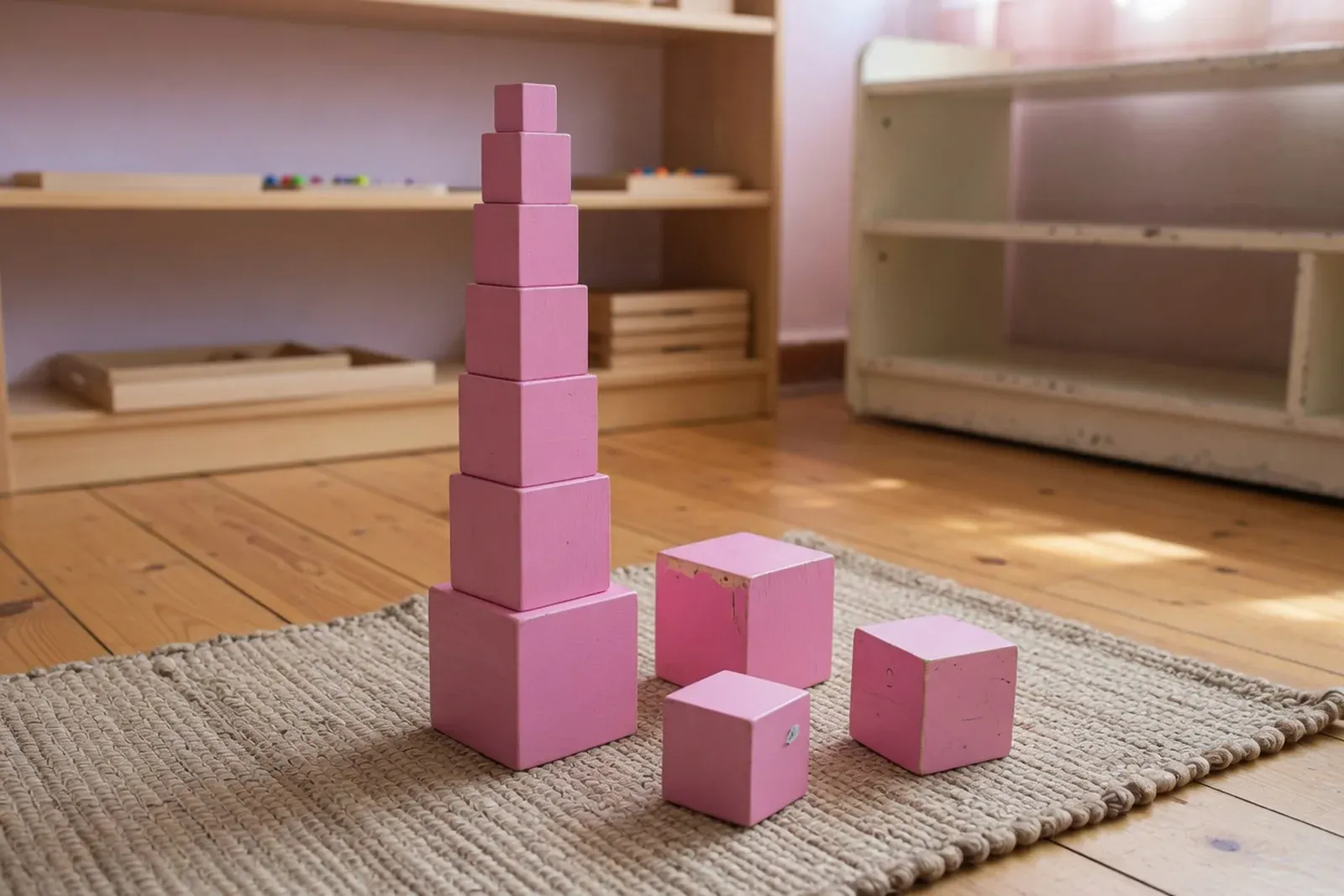
Montessori materials are not decorations. A trained guide presents them in a sequence, each material isolates a skill or concept, and many include a built-in way for the child to notice an error without waiting for adult correction. The pink tower isolates size discrimination before a child ever measures anything on paper. Sandpaper letters connect sound to symbol through touch, and the golden beads turn quantity into something a child can hold and exchange. Metal insets, the geometric stencils children trace with a pencil, exist because handwriting is a motor skill before it is an academic one. The binomial cube, a set of colored wooden blocks that fit together only one way, quietly prepares the hand and eye for algebra years before a child sees an equation written down. Each material belongs to a longer progression. One recognizable item on a shelf does not create a Montessori classroom.
Ask a guide to choose one material and explain what comes before it, what the child learns from it, and what follows. A precise answer shows that the shelves form a curriculum. Also notice whether pieces are complete, orderly, accessible, and ready for independent use. A good environment may include books, art supplies, puzzles, and carefully chosen open-ended items, but “mostly wooden” is not the standard.
4. Why are children grouped across ages, and do they stay for the full cycle?
Mixed-age grouping is structural, not incidental. Over a typical three-year cycle, a child moves from newcomer to capable peer, then to an older classroom member who can model routines and support others. The guide gains time to know the child, observe growth, and build lessons in sequence. Children also learn beside classmates working at different levels without treating every difference as a ranking.
Ask which ages share a room, how long children normally remain, and what changes in the final year. In an Early Childhood community, that final year is often kindergarten, when children can consolidate earlier work and take on greater responsibility. If a school separates children strictly by single-year ages or routinely loses the oldest group, ask how it preserves the benefits it claims for mixed ages.
Curious what this looks like in a real classroom?
Schedule a Visit5. What may children choose, and what limits guide those choices?
“Children can do whatever they want” is a misunderstanding of Montessori freedom. Choice exists inside a carefully prepared environment and a clear social structure. A child usually chooses from work that has been presented, uses it respectfully, returns it ready for the next person, and avoids disrupting someone else’s concentration. The guide steps in when a child needs a lesson, a new challenge, redirection, or help repairing harm.
Ask what happens when a child chooses the same easy work every day, declines an important lesson, or misuses a material. A strong answer balances independence with active observation. It should sound neither permissive nor controlling. For a closer look at this balance, see Montessori in practice.
6. What is the ratio, and what are the adults doing?
A ratio matters, especially for toddlers, but a number alone cannot prove Montessori quality. Ask for the number of children and adults in the room, the role and training of each adult, and what happens when someone is absent. Then watch the room. Are adults giving quiet lessons and observing, or directing the whole group from one task to the next? Do they help children do things for themselves, or complete every task for them?
Ratios should match the children’s ages and needs. At Montessori School of Fairfax, the Toddler program has a 3:1 student-teacher ratio. At every level, the useful question is whether staffing allows adults to protect safety, offer lessons, observe carefully, and avoid becoming the center of all activity.
7. May parents observe a normal work period?
A prepared tour is helpful, but observation answers questions that a conversation cannot. Ask whether you can watch part of an ordinary morning, when children have settled into the work cycle. Look for sustained concentration, movement with purpose, materials being returned, and adults speaking quietly with individuals or small groups. The room need not be silent. Productive classrooms include conversation, collaboration, and the ordinary work of a community.
Schools may limit where you stand, how long you watch, or whether you enter the room because they must protect children’s privacy, security, and concentration. That is reasonable. What matters is transparency: the school explains its policy and offers a genuine way to see daily practice. A tour that shows only empty classrooms or a staged group lesson gives you less useful evidence.
8. How do guides track progress and respond when a child struggles?
Montessori avoids constant whole-class pacing, but it does not leave progress to chance. Guides observe, record presentations and follow-up work, notice patterns, and plan next lessons. Ask how they know when a child has mastered a skill, how families hear about progress, and what they do when observation shows that a child is stuck.
A thoughtful answer should include both the Montessori sequence and the individual child. The guide may present a concept another way, return to an earlier material, reduce distractions, invite more practice, or collaborate with the family. Be cautious if “children learn at their own pace” is used to avoid explaining academic expectations, documentation, or support. Respecting a child’s pace requires close attention, not passive waiting.
Use the answers together
No single object, credential, ratio, or schedule proves that a school is authentic. Look for alignment. Trained guides should use sequenced materials during a protected work cycle. Mixed-age groups should support a full developmental cycle. Freedom should come with clear limits. Observation and record keeping should shape what happens next.
You are not trying to catch a school using the wrong vocabulary. You are deciding whether its daily practices deserve your trust. Ask for details, watch the children and adults, and give more weight to what you can see than to what appears in a brochure.