Montessori vs. Daycare in Fairfax County
Admissions
The right question is not which label sounds better. It is what kind of day, relationship, and support will help your child and your family thrive.
When you search for care for a baby, toddler, or preschooler in Fairfax County, the choice can seem to arrive already labeled: Montessori or daycare. But most parents are asking something more practical. Who will know my child? Will they be safe and cared for while I work? What will their day feel like? Will this setting support the person they are becoming?
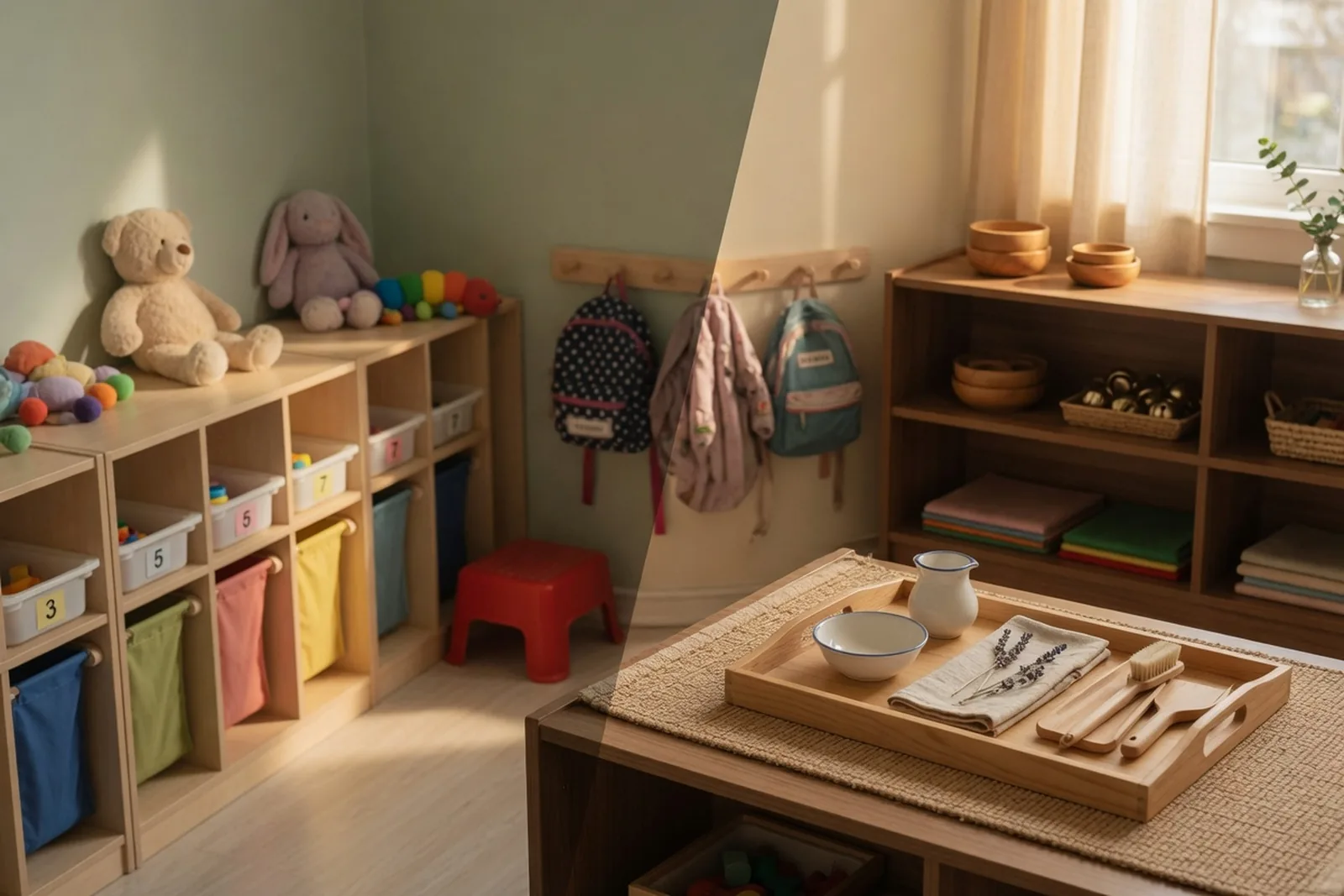
Daycare and Montessori programs can both meet real family needs. Many daycare providers offer dependable schedules, caring adults, friendships, and a welcoming place for children to spend their days. Montessori schools also provide care, especially for working families. The difference is usually in how the day is organized and what adults expect children to do within it.
Care and education are not opposites
For young children, care is education. A child learns from the way an adult helps with a coat, responds to a hard goodbye, prepares a snack, and makes room for an attempt before stepping in. The question is not whether a program is caring. It is whether its routines give children a chance to participate, practice, and build confidence.
In a typical daycare setting, the day may be shaped around group transitions: everyone moves from free play to snack, then to a teacher-led activity, then outside. That rhythm can work well for many children and families. It offers predictable supervision and a shared schedule.
In a Montessori classroom, the environment is prepared so children can do more for themselves. Low shelves, child-sized tools, and carefully arranged materials invite a child to choose purposeful work, return it when finished, and try again. Guides watch closely and offer lessons when a child is ready. The classroom still has routines, meals, rest, outdoor time, and clear boundaries. It simply makes more room for individual concentration inside the day.
For a toddler, that might mean carrying a small pitcher to pour water, putting a napkin on the table, buttoning a dressing frame, or choosing a work with spoons and bowls. These are ordinary actions, but they build coordination, language, and a growing sense of capability. In a strong program, no adult expects independence before a child is ready. Adults prepare the conditions and stay close enough to help.
What Montessori may feel like for your child
A Montessori classroom often feels calmer than a busy room because children are not all doing the same thing at once. One child may be matching objects, another may be washing a table, and another may be listening to a short lesson. Children move with purpose, and adults protect time for them to focus.
That does not mean every moment is quiet or every child works alone. Young children talk, make mistakes, need comfort, and learn alongside peers. The goal is not silence. The goal is an environment where a child can follow an interest long enough to make progress.
Montessori also tends to look beyond a single academic activity. A child who prepares snack is practicing sequencing, hand control, courtesy, and responsibility. A child who chooses a puzzle and persists is learning to manage frustration. A child who watches an older classmate tie a shoe sees a useful skill in action. By the Early Childhood years, that same daily practice extends into sandpaper letters, golden beads, and the moveable alphabet. Those experiences do not replace reading, writing, or mathematics. They help create the attention and confidence that make later academic work more meaningful.
At Montessori School of Fairfax, the Toddler program serves children from 18 months to 3 years with a 3:1 toddler ratio. For families comparing options for a very young child, it can be helpful to see what a prepared environment and close adult support look like together.
Curious what this looks like in a real classroom?
Schedule a VisitThe cost question often has more overlap than parents expect
It is reasonable to begin with the budget. In Fairfax County, full-time infant and toddler daycare can cost as much as a Montessori program, or close enough that the difference is smaller than families assume.
That comparison is not a promise that every Montessori school costs the same as every daycare center. Schedules, age groups, included meals, extended care, deposits, and enrollment terms all affect the total. A part-time program and a full-day program are not comparable just because they use the same label.
Ask each provider for the complete annual and monthly picture. Include registration, materials, late pickup, meals, summer care, and any hours outside the core day. Then consider what you are receiving during those hours. For one family, the best fit may be the shortest commute and the longest day. For another, it may be an environment with a particular approach to independence and learning. Both are valid priorities.
Questions worth asking any provider
A tour should give you more than a polished room and a tuition sheet. Whether you visit a Montessori school, a daycare center, or an in-home provider, use the same questions to understand the daily experience.
- What does a typical morning look like, including arrival, meals, rest, outdoor time, and transitions?
- How many children is each adult responsible for, and does that ratio change at different points in the day?
- What happens when a child is upset, biting, struggling to separate, or having a conflict with a peer?
- How do adults share observations about my child, beyond a report of naps and meals?
- How long do teachers or guides usually stay, and who will know my child well?
- How are children invited to make choices, practice self-care, and solve small problems?
- What is included in tuition, and what additional fees should I plan for across the year?
Watch the adults as carefully as you watch the room. Do they speak to children with respect? Do they get down to a child's level? Do they step in quickly when needed, but leave room for a child to attempt a task? The answers on a brochure matter, but the interactions you see usually tell you more.
How to decide what fits your family
There is no universal winner in Montessori versus daycare. There is the setting that gives your child steady relationships, your family workable hours, and a daily rhythm you can feel good about. A child who needs a gradual start may need a provider with a patient transition plan. A family with an early commute may need care that opens before the formal school day. A child who is eager to do things independently may flourish where the environment invites that effort.
Try to visit while children are settled into their day, not only at a scheduled open house. Notice whether the room feels organized without feeling rigid. Notice whether children are waiting for adults or actively engaged. Notice whether you can imagine your child being comforted there on a hard morning and proud there on an ordinary afternoon.
At Montessori School of Fairfax in Chantilly, VA, families can see programs for children ages 18 months to 12 years and ask candid questions about the daily schedule. The school serves about 130 students, and offers Toddler, Early Childhood, Kindergarten, Elementary, and Enrichment programs. A visit is not about being persuaded by a label. It is a chance to look closely, ask what matters, and decide whether the environment feels right for your family.