Montessori and Kindergarten Readiness
The question underneath most kindergarten-readiness questions is simple: will my child be okay when the room gets bigger, the routine changes, and I am not there to help? It is a fair question. It is also broader than whether they can write their name, count to 20, or complete a page of letter practice.
Those skills can be useful, but kindergarten asks children to do something more demanding. They need to enter a group, listen for what comes next, care for their belongings, ask for help clearly, recover from disappointment, and keep trying when a task is not easy the first time. Academic knowledge matters. The habits that let a child use that knowledge matter just as much.
When parents ask whether Montessori prepares children for kindergarten, it helps to start there. Readiness is not a checklist to finish by August. It is a set of growing capacities that make school feel manageable, interesting, and safe.
Readiness is more than worksheet skills
A child who recognizes every uppercase letter may still struggle if they cannot wait for a turn, follow a two-step direction, or move on after a mistake. Another child may know fewer letters but arrive ready to participate, concentrate, and learn quickly because those foundations are already in place.
Three areas are especially important:
- Self-regulation. Can your child pause before grabbing, use words when frustrated, and settle into an activity for a while? Self-regulation does not mean perfect behavior. It means a child is beginning to notice their feelings and use support, routines, or strategies to respond.
- Language. Can they understand everyday directions, tell you what happened, join a conversation, and ask a question when they are confused? Rich language supports friendships, problem-solving, and early reading.
- Independence. Can they manage a coat, lunch container, bathroom routine, backpack, or a small classroom job with growing confidence? Each successful ordinary task tells a child, “I can handle this.”
Fine-motor control, early number sense, print awareness, and the ability to use a pencil also belong in the picture. But these skills develop most usefully when they connect to real work. A child pouring water carefully, fastening a button, arranging objects by size, or building a word with letter tiles is preparing hands and mind at the same time.
What kindergarten teachers tend to notice first
Ask kindergarten teachers what helps a new student most, and the answers often sound less like an academic placement test and more like a description of daily life. They value children who can enter the room, unpack, join a group, and begin a task. They notice children who can persist for a few minutes without constant adult attention, communicate a need, and work through small social conflicts.
Teachers also appreciate children who know that adults can help without doing everything for them. “I spilled my water. What should I do?” is a powerful sentence. So is “Can you show me the first step?” These are signs of a child who expects to participate in solving the problem.
That does not mean a ready child is always cheerful, quiet, or confident. Kindergarten is a transition, and transitions can be hard. A child may cling at drop-off, hesitate in a new group, or need reminders for months. The goal is not to eliminate those moments. The goal is to give them enough practice with routines, responsibility, and repair that they have somewhere to stand when the newness arrives.
Why worksheets can give a false signal
Worksheets are easy to measure. A page comes home with letters traced or numbers circled, and everyone can see what happened. But a completed page does not tell you whether the child chose the work, understood it, held attention through it, or could apply the idea in a new setting.
Young children learn through movement, repetition, conversation, and direct experience. They learn quantity by handling groups of objects before seeing a numeral on paper. They hear the sounds in words before decoding a reader. They build control of the hand by carrying, cutting, sorting, and drawing. Paper can have a place, especially as children grow. It should not be mistaken for the whole picture.
At home, the most helpful preparation may look almost too ordinary to count: inviting your child to set the table, put dirty clothes in a basket, choose between two weather-appropriate shirts, help make a grocery list, or clean up a spill. These jobs build sequencing, coordination, vocabulary, and responsibility. More importantly, they let a child experience themselves as capable.
Curious what this looks like in a real classroom?
Schedule a VisitHow the Montessori kindergarten year brings the pieces together
In a Montessori Early Childhood classroom, kindergarten is often the capstone year of a three-year cycle. The child is no longer learning the room from the outside. They know where materials belong, how the daily rhythm works, and what it feels like to make a choice and carry it through. That familiarity creates room for more complex academic work and more meaningful responsibility.
A kindergartener may help welcome a newer child, demonstrate how to roll a work rug, or explain where a material belongs. Teaching a younger classmate requires patience, clear language, and real mastery. It also gives the older child a visible role in the community. Leadership at 5 or 6 is not standing at the front of a room. It is noticing what needs doing and knowing how to help.
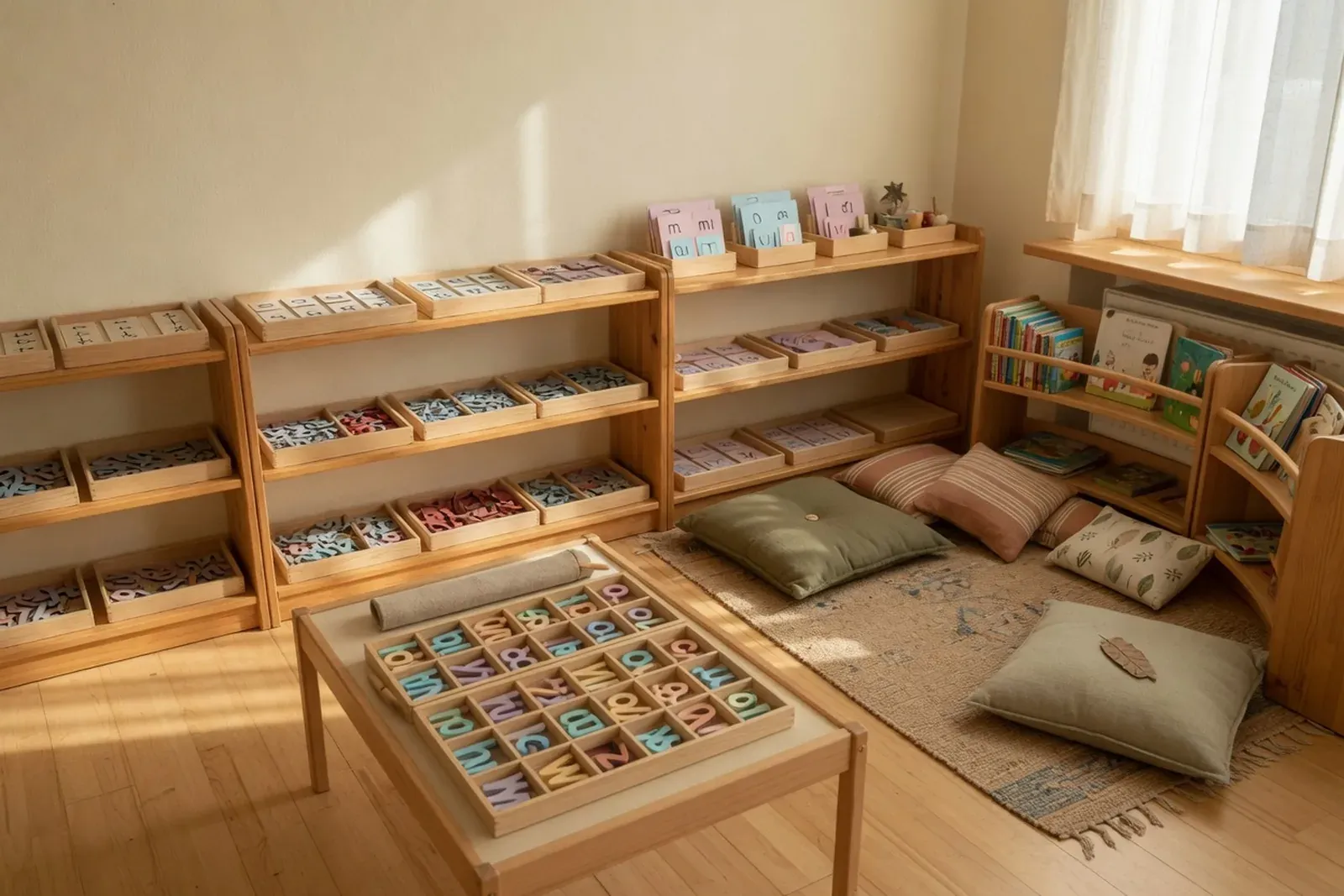
The academic progression is concrete, too. Children who have spent time connecting sounds to sandpaper letters can use a moveable alphabet to build words and sentences. Children who have worked with the golden beads, exchanging ten units for a ten-bar and ten ten-bars for a hundred square, move into the stamp game with a real sense of what the numbers stand for. Writing, reading, mathematics, concentration, and order reinforce one another instead of arriving as separate subjects.
This is why a strong Montessori kindergarten experience is not simply preschool with an extra year attached. It is a year in which earlier practice becomes fluency. The child has more freedom because they have more skill, and more responsibility because they are ready to carry it. You can learn more about how that year is structured in our Kindergarten program.
How to support readiness without turning home into school
You do not need a color-coded curriculum at the kitchen table. Start with a predictable rhythm, a few manageable responsibilities, and time for your child to do things slowly. Build in enough margin for them to zip the coat, pour the cereal, and put the book back rather than having an adult rush ahead.
Read aloud every day, even for a short stretch. Talk about what you notice on walks, at the store, and while cooking. Let your child retell a story in their own words. Play games that involve taking turns, following rules, and losing graciously. When a frustration comes up, name it calmly and help them choose a next step: take a breath, ask for help, try another way, or come back later.
It also helps to give children practice being apart from you in trusted settings and to talk plainly about what school will be like. Describe the routine without making it a performance: you will hang up your things, say goodbye, find your teacher, choose work, eat snack, play outside, and then I will come back. Familiar language makes a future day easier to picture.
The question worth asking
Instead of asking only, “Is my child ahead?” try asking, “What can my child do for themselves, with others, and when something feels hard?” That question leaves room for the whole child. It also points toward preparation that lasts beyond the first weeks of kindergarten.
Children do not need to arrive finished. They need a chance to arrive practiced: practiced at trying, communicating, caring for their work, and belonging to a group. Those are the tools that help academic skills take root.